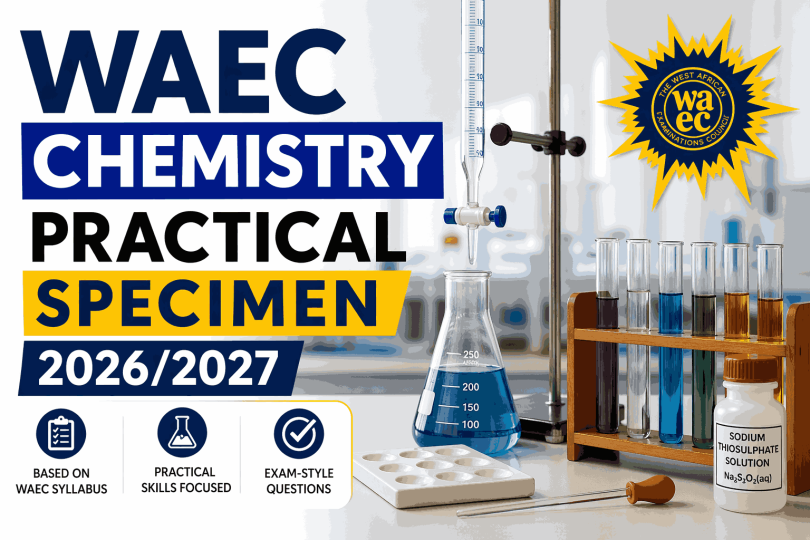

WAEC Chemistry Practical Specimen: Are you preparing for West African Examinations Council and looking for Chemistry Practical Specimen for 2026/2027? If you’ve been asking questions like “What specimens will West African Examinations Council Chemistry practical use?”, “What should I expect in the exam?”, or “How can I prepare effectively?”, then this guide is for you. West African Examinations Council Chemistry practical is a very important part of the exam that tests your ability to carry out experiments, make observations, identify substances, record results, and explain chemical reactions.
This guide presents the likely West African Examinations Council Chemistry Practical Specimen 2026/2027, explains each specimen, and shows you how to prepare effectively.
About West African Examinations Council Chemistry Practical Specimen
West African Examinations Council Chemistry Practical Specimen refers to the set of chemicals, apparatus, solutions, and laboratory materials provided during the practical examination to test candidates’ understanding of chemistry through experiments and analysis. These specimens may include acids, bases, salts, indicators, metals, organic compounds, measuring cylinders, burettes, pipettes, test tubes, and heating apparatus used for different practical tasks. Students are usually required to carry out titration, qualitative analysis, observe colour changes, identify gases evolved, record measurements, calculate results, and write balanced equations where necessary.
In some cases, simple experiments may also be included to test knowledge of separation techniques, rates of reaction, solubility, or heat changes. The main purpose of the practical specimen exam is to assess a student’s accuracy, observation skills, calculation ability, reasoning, and overall understanding of important chemical concepts learned in class. Candidates who study common practical questions early and practice regularly often perform better in the examination.
WAEC Chemistry Practical Specimen 2026/2027
Below are likely specimens that may be provided: Chemical Specimens
- Specimen A – Hydrochloric Acid Solution
- Specimen B – Sodium Hydroxide Solution
- Specimen C – Unknown Salt Solution
- Specimen D – Zinc Granules
- Specimen E – Copper(II) Sulphate Crystals
- Specimen F – Distilled Water
- Specimen G – Methyl Orange Indicator
WAEC Chemistry Apparatus Provided
Candidates may also be given:
- Burette
- Pipette
- Conical flask
- Beaker
- Test tubes and rack
- Measuring cylinder
- Bunsen burner
- Filter funnel
- White tile
- Wash bottle
WAEC Chemistry Practical Questions and Answers 2026 (Practice/Revision)
Instructions: Study the specimens carefully and answer all questions. Write your answers clearly. Show all workings where necessary.
Specimen List
- Specimen A – Hydrochloric Acid Solution
- Specimen B – Sodium Hydroxide Solution
- Specimen C – Unknown Salt Solution
- Specimen D – Zinc Granules
- Specimen E – Copper(II) Sulphate Crystals
- Specimen F – Distilled Water
- Specimen G – Methyl Orange Indicator
Question 1
(a) Using specimens A and B, carry out an acid-base titration.
(b) Record your rough and accurate readings.
(c) Calculate the average titre value.
Answers:
(a) Neutralization titration performed.
(b) Example readings:
| Titration | Final Reading (cm³) | Initial Reading (cm³) | Titre (cm³) |
|---|---|---|---|
| Rough | 25.30 | 0.00 | 25.30 |
| 1st | 25.00 | 0.00 | 25.00 |
| 2nd | 24.90 | 0.00 | 24.90 |
(c) Average titre = 24.95 cm³
Question 2
(a) Add specimen A to specimen D.
(b) State your observations.
(c) Name the gas evolved.
Answers:
(a) Reaction carried out.
(b) Effervescence occurred and bubbles were produced.
(c) Hydrogen gas.
Question 3
(a) Heat specimen E strongly.
(b) State two observations.
Answers:
(a) Heating carried out.
(b)
- Blue crystals turned white.
- Water droplets formed on cooler part of test tube.
Question 4
(a) Perform tests on specimen C.
(b) State the likely salt present.
Answers:
(a) Example observations:
- White precipitate with sodium hydroxide.
- White precipitate insoluble in excess.
(b) Calcium salt or aluminium salt.
Question 5
(a) State one use of specimen F.
(b) State one function of specimen G.
Answers:
(a) Used for preparing solutions or rinsing apparatus.
(b) Used to detect end point in titration by colour change.
Likely Repeated West African Examinations Council Practical Topics for 2026
- Acid-base titration
- Qualitative salt analysis
- Gas tests
- Heating of hydrated salts
- Separation techniques
- Rates of reaction
- Mole calculations
Practical Tips for West African Examinations Council Chemistry
- Read instructions carefully
- Record correct readings
- Use apparatus properly
- Observe colour changes closely
- Write balanced equations where needed
- Show all calculations clearly
Important Information
- West African Examinations Council practical questions often repeat in pattern
- Accuracy carries many marks
- Observation tables are important
- Units must be correct
- Time management is important
Conclusion
Preparing early with West African Examinations Council Chemistry Practical Specimen 2026/2027 is one of the smartest ways to succeed in the examination. It helps students become familiar with the type of chemicals, apparatus, questions, and practical tasks that may appear during the exam. When you already know what to expect, fear and confusion reduce, and your confidence increases greatly on the examination day. Many students fail practicals not because they are difficult, but because they do not practice enough before the exam.
Consistent preparation also improves important skills needed to score high marks in Chemistry practical. These skills include accurate measurement, neat recording of results, correct observation, calculation, proper handling of apparatus, and giving correct chemical explanations. The more you practice with past practical questions and likely specimens, the faster and easier it becomes to answer practical questions correctly. With dedication, regular revision, and proper guidance, you can perform excellently and boost your overall Chemistry result.
Frequently Asked Questions (FAQs)
What is West African Examinations Council Chemistry practical specimen?
It refers to the chemicals, solutions, salts, apparatus, or materials provided during the practical examination for candidates to carry out experiments, observe reactions, and answer questions.
Is West African Examinations Council Chemistry practical difficult?
No, it becomes easier with regular practice and proper understanding of experiments.
What usually comes out in Chemistry practical?
Common practical topics include titration, qualitative analysis, gas tests, heating experiments, and calculations.
How can I pass West African Examinations Council Chemistry practical?
Practice titration, study reactions, know colour changes, learn calculations, and revise past questions regularly.
Are West African Examinations Council Chemistry practical questions repeated?
Yes, similar practical formats and question patterns are often repeated.
RELATED POST
- WAEC Biology Practical Specimen 2026/2027
- WAEC Physics 2025 Past Questions and Answer | Objective and Theory
- WAEC Chemistry Practical Specimen 2026/2027
- WAEC Physics Practical Specimen 2026/2027