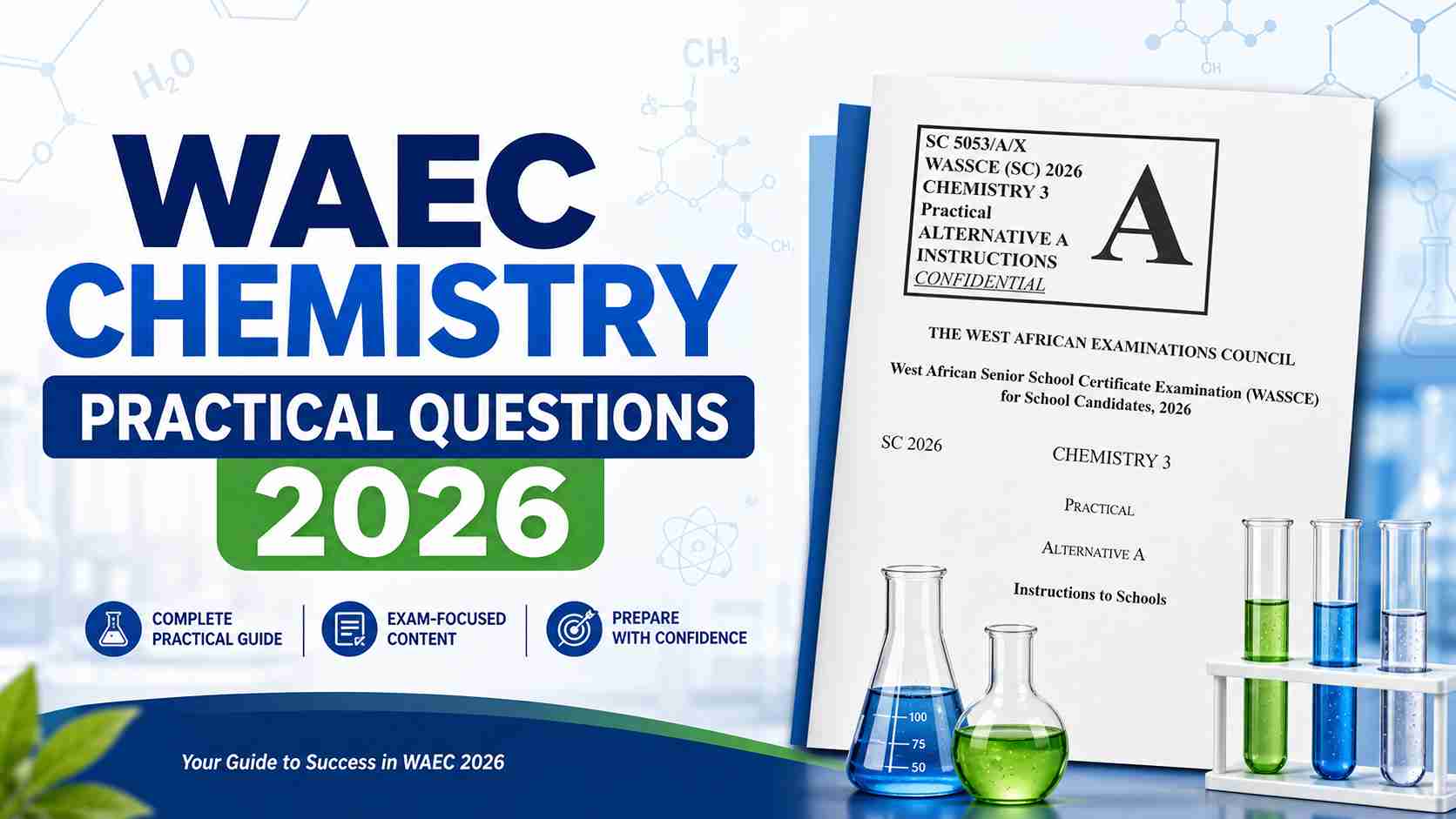

WAEC Chemistry Practical Questions 2026: Are you preparing for the 2026 WAEC Chemistry exam? One of the key components of the exam is the practical section, which often causes students to feel uncertain about how to approach it. The good news is that with the right preparation and understanding, you can excel in the practicals and secure a top score.
In this post, we will guide you through what to expect from the WAEC Chemistry practical exam and provide a detailed breakdown of practical questions (with placeholders) that will help you prepare for the 2026 exam. While the official questions are yet to be released, we have crafted a practical template that mirrors the structure and type of questions commonly asked in previous years.
WAEC Chemistry Practical 2026: What to Expect
The WAEC Chemistry practical exam is designed to assess your ability to perform chemical experiments, record accurate observations, and make logical conclusions based on your findings. The practical exam usually includes a mix of qualitative and quantitative tests, including titration, pH determination, and chemical identification.
Although the official 2026 questions are yet to be released, you can still prepare by understanding the type of questions likely to appear. Here’s an example of what the Chemistry practical exam might look like for 2026:
WAEC Chemistry Practical Questions Instructions:
- Ensure you are familiar with all chemicals and safety protocols before beginning any experiment.
- Always wear your protective gear (gloves, goggles, lab coat).
- Record all your observations clearly and concisely. Your conclusions should follow logically from your results.
Practical 1: Identification of Chemicals
Loading…
You are provided with three colorless solutions: A, B, and C. Perform the following tests on each solution:
- Test the solution with litmus paper.
- Add a few drops of silver nitrate solution to each sample.
- Record your observations and identify the solutions based on the reactions you observe.
Practical 2: Determining the pH of Solutions
Loading…
In this experiment, you are given two solutions, X and Y. Use a pH meter or universal indicator to determine and record the pH of each solution. Once you have the results, explain what they indicate about the nature of the solutions.
Practical 3: Titration
Loading…
For this experiment, you will be provided with hydrochloric acid (HCl) and sodium hydroxide (NaOH) solutions of unknown concentrations. Perform a titration to determine the concentration of NaOH using HCl as the titrant.
Instructions:
- Measure the volume of NaOH and HCl used.
- Record the volume of HCl required to neutralize the NaOH solution.
- Calculate the concentration of NaOH from your findings.
ALSO READ: WAEC Physics Practical Questions 2026: A Comprehensive Guide for Students
Practical 4: Determining the Rate of a Reaction
Loading…
For this experiment, you will be provided with a solution of sodium thiosulphate and hydrochloric acid. The goal is to determine how the rate of the reaction changes with varying concentrations of sodium thiosulphate.
Instructions:
- Measure the time taken for the reaction to occur at different concentrations of sodium thiosulphate and hydrochloric acid.
- Plot a graph of concentration versus time and determine the rate of the reaction.
- Analyze how changes in concentration affect the reaction rate.
How to Prepare for WACE Chemistry Practical 2026
Preparation for the Chemistry practical exam involves more than just memorizing formulas and reactions. Here are some essential tips to help you excel:
- Understand the Syllabus: Familiarize yourself with the topics listed in the official WAEC Chemistry syllabus. Focus on both theory and practical aspects to gain a well-rounded understanding of the subject.
- Practice Regularly: One of the best ways to improve your practical skills is by practicing experiments regularly. Try to replicate common experiments at home or in school labs. This will improve your technique and boost your confidence.
- Use Past Questions: Although the 2026 questions aren’t out yet, practicing with past WAEC Chemistry practical questions will give you an idea of what to expect. Focus on the types of tests and calculations often included in the exams.
- Work on Safety Protocols: Understanding lab safety is crucial. Always follow safety guidelines to prevent accidents and ensure a smooth practical session.
- Time Management: Practicals often come with a time limit, so practicing under timed conditions will help you work efficiently and accurately during the exam.
Conclusion
While we are still waiting for the official release of the WAEC Chemistry Practical questions for 2026, using this template can guide you in your preparation. Stay focused, practice regularly, and ensure you’re familiar with the various experiments and calculations that could appear on the exam.
Make sure to check back for updates once the actual questions are released, and always aim to stay one step ahead by practicing effectively. Good luck with your preparations, and remember that success comes with consistency and smart studying!
Frequently Asked Questions
Is the WAEC Chemistry Practical exam difficult?
The practical exam can seem intimidating, but with proper preparation, it becomes manageable. Focus on your understanding of the concepts and practice regularly.
Where can I find WAEC Chemistry past questions?
You can find past questions on various educational websites, bookstores, and mobile apps designed for WAEC preparation.
How do I pass the Chemistry practical?
Practice and understand the fundamental concepts behind the experiments. Knowing your materials and procedures will help you perform confidently during the exam.
