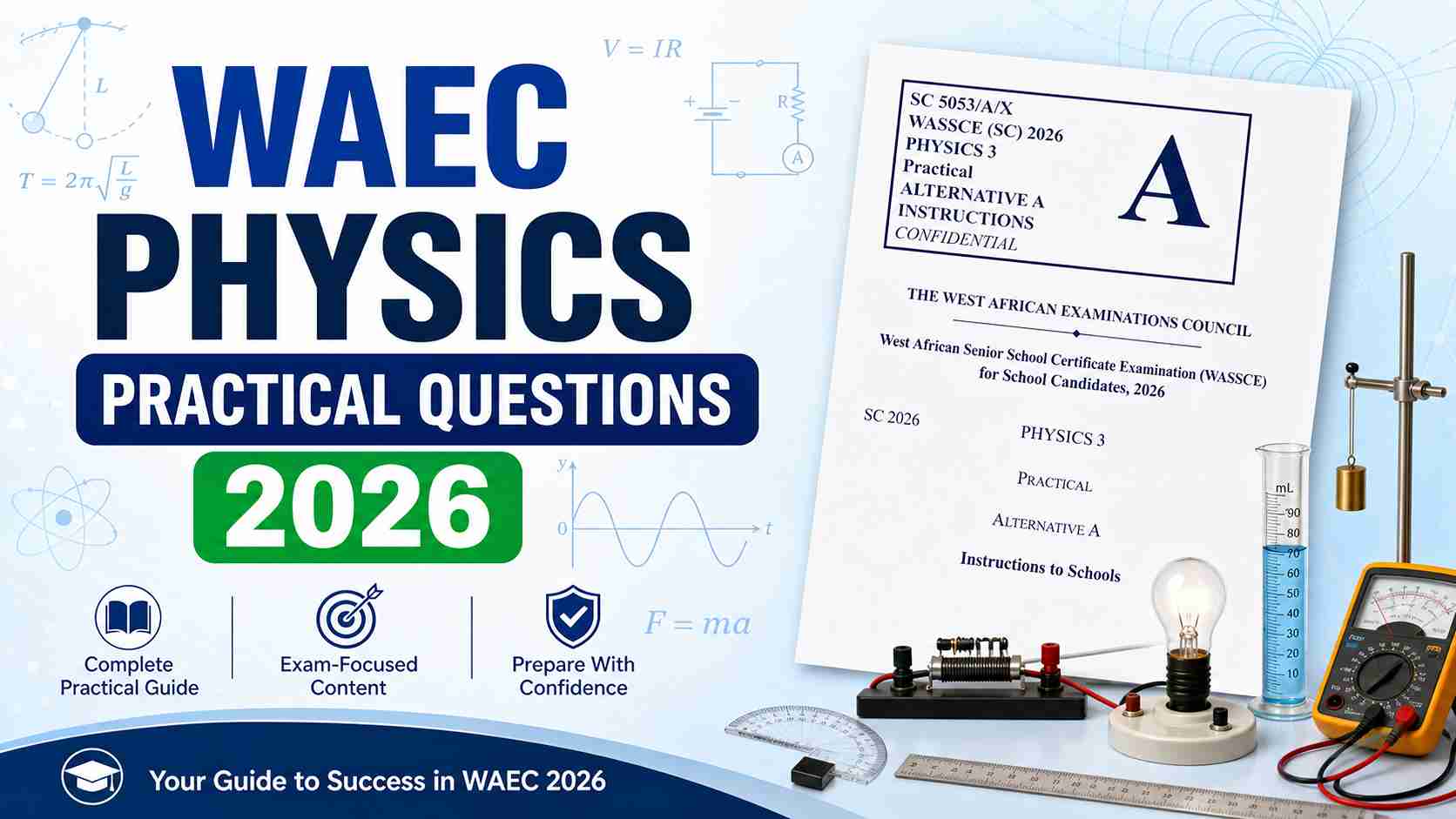

Are you preparing for the 2026 WAEC Physics exam? One of the most critical sections of the exam is the practical portion, which often leaves students uncertain about how to approach it. Don’t worry – with the right preparation and understanding, you can tackle the practicals confidently and achieve great results.
In this post, we’ll guide you through what to expect from the WAEC Physics practical exam and provide a detailed breakdown of practical questions (with placeholders) to help you prepare for the 2026 exam. While the official questions haven’t been released yet, we’ve created a practical template reflecting the structure and typical question types that usually appear.
WAEC Physics Practical 2026: What to Expect
The WAEC Physics practical exam is designed to assess your ability to perform experiments, record accurate observations, and make logical conclusions based on your findings. It typically includes both qualitative and quantitative experiments covering various physics topics like mechanics, optics, electricity, and magnetism.
Although the 2026 official questions are not out yet, you can still prepare by understanding the types of experiments and practical tasks commonly asked in previous years. Here’s a preview of what the Physics practical exam could look like for 2026:
Sample Practical Questions
Loading…
WAEC Physics Practical Questions 2026 Instructions:
- Be familiar with all the equipment and safety protocols before starting any experiment.
- Always wear your protective gear (gloves, goggles, lab coat) during practicals.
- Record your observations clearly and concisely, ensuring your conclusions are logical and based on your results.
Practical 1: Determining the Acceleration Due to Gravity
Loading…
In this experiment, you will measure the time taken for a ball to fall a known distance under the influence of gravity.
Instructions:
- Drop a ball from a known height.
- Measure the time it takes to hit the ground.
- Calculate the acceleration due to gravity based on your observations.
- Discuss how the result compares to the accepted value of gravity.
Practical 2: Investigating Ohm’s Law
Loading…
You are given a circuit with a resistor, a power supply, and an ammeter. The objective is to verify Ohm’s Law.
Instructions:
- Set up a circuit with a resistor and ammeter.
- Measure the current for different voltages.
- Record your results and plot a graph of current (I) versus voltage (V).
- Verify whether the relationship between current and voltage is linear, as stated by Ohm’s Law.
RECOMMENDED: WAEC Biology Practical Questions 2026: A Comprehensive Guide for Students
Practical 3: Determining the Refractive Index of a Material
Loading…
In this experiment, you will investigate the refractive index of a transparent material using a ray of light.
Instructions:
- Shine a ray of light through a transparent material (e.g., glass or plastic).
- Measure the angle of incidence and the angle of refraction.
- Use Snell’s Law to calculate the refractive index of the material.
Practical 4: Investigating the Magnetic Field of a Current-Carrying Wire
Loading…
You are tasked with investigating the magnetic field created by a current-carrying wire.
Instructions:
- Set up a circuit with a wire and a power supply.
- Place a compass near the wire to observe the direction of the magnetic field.
- Measure the strength of the magnetic field at various distances from the wire.
- Discuss how the current and distance affect the magnetic field.
How to Prepare for WAEC Physics Practical 2026
Preparation for the Physics practical exam is about more than just reading theories and formulas – it’s about practicing hands-on experiments and developing your understanding of key concepts. Here are some tips to help you prepare effectively:
Understand the Syllabus: Ensure you are familiar with all topics listed in the WAEC Physics syllabus. Study both theoretical concepts and practical experiments to ensure you are well-rounded.
Practice Regularly: The best way to excel in practical exams is by practicing regularly. Replicate common experiments in school or at home to improve your technique and boost your confidence.
Use Past Questions: Although the 2026 practical questions aren’t out yet, practicing with past WAEC Physics practical questions will give you a sense of the types of experiments you might encounter. Pay attention to the formats and types of calculations involved.
Focus on Lab Safety: Understanding lab safety is crucial in the Physics practical exam. Always follow safety guidelines, such as using equipment properly and wearing the right protective gear.
Work on Time Management: The practical exam often has a time limit. Practice working under time constraints so you can efficiently complete the experiments and still have time to analyze and record your results.
Conclusion
While we are still awaiting the official release of the WAEC Physics Practical questions for 2026, this template will give you a strong foundation to guide your preparation. Stay focused, practice regularly, and familiarize yourself with the experiments and calculations likely to appear in the exam.
Check back for updates once the actual questions are released. In the meantime, continue practicing and stay ahead by being well-prepared. Good luck with your studies – remember, success comes with consistency and smart preparation!
Frequently Asked Questions
Is the WAEC Physics Practical exam difficult?
The Physics practical exam can be challenging, but with regular practice and understanding of key concepts, it becomes manageable. Focus on mastering the practical skills and applying the theory behind the experiments.
Where can I find WAEC Physics past questions?
WAEC Physics past questions are available in bookstores, educational websites, and mobile apps specifically designed for WAEC preparation.
How do I pass the Physics practical exam?
To pass the Physics practical exam, understand the procedures for each experiment, practice regularly, and ensure you are familiar with the equipment and calculations involved. Time management during the exam is also essential.
Stay well-prepared and give yourself the best chance for success.
